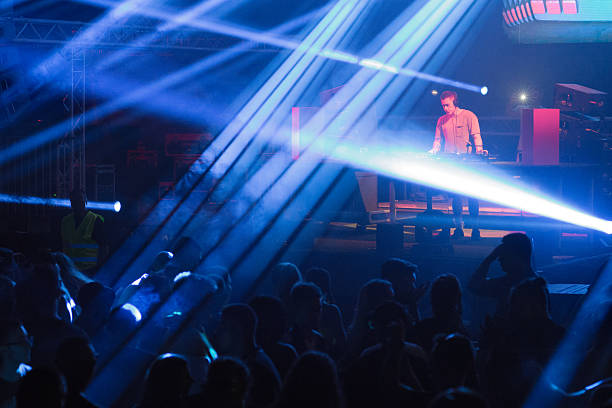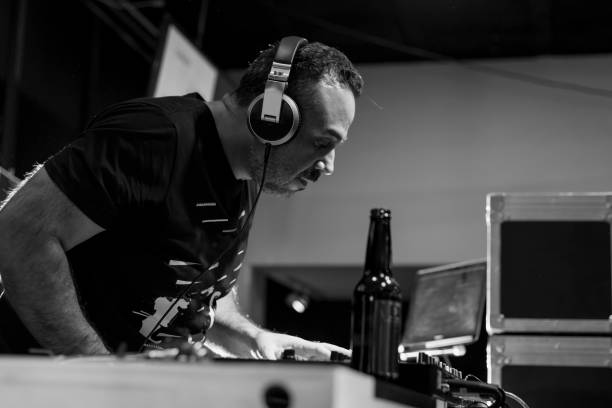
You know that moment in your bedroom or booth when a track hits just right, and you close your eyes, feeling the beat in your chest? Now imagine that same rush, except the music isn’t just coming from two speakers in front of you. It’s swirling around your head like a sonic vortex, with percussions dancing behind your ears, bass rumbling from beneath your feet, and vocals whispering from above like a ghost in the club. This isn’t some sci-fi fantasy or a VR gimmick. This is ambisonics for surround sound DJing, and it’s about to flip the DJ world on its axis.
If you’ve been following the immersive audio formats subsection of this guide, you already know the game is changing. We’ve moved past stereo. We’ve even moved past basic 5.1 and 7.1 surround. Ambisonics is the next leap, a full-sphere audio capture and playback method that maps sound in three dimensions. Think of it like Dolby Atmos on steroids, but more flexible and built for live performance. For DJs, this means your mix isn’t just a flat wall of sound anymore. It becomes a 360-degree playground where you can place elements of a track anywhere in the room, move them around in real time, and give your crowd an experience that’s closer to a live band playing inside their skulls than a traditional club set.
Let’s get into the practical stuff. How does a DJ even work with ambisonics? Right now, the barrier to entry is dropping fast. Software like Ableton Live, Reaper, and even some advanced Traktor and Serato setups are starting to support third-order ambisonic plugins. Hardware-wise, you’ll want a multi-channel audio interface, because you’re no longer sending two channels out to the PA. You’re sending anywhere from four to sixteen channels, which get decoded into a speaker array or a pair of binaural headphones. For the club, this means venues need to install immersive speaker rings—like the L-Acoustics L-ISA system or d&b Soundscape. But here’s the cool part: you can also mix for headphones. Imagine dropping a headphone-only mix on SoundCloud that lets listeners feel like they’re standing in the middle of your booth, hearing every track element orbit their head.
The real magic, though, is in the creativity. As a DJ, you’re no longer constrained by the left-right pan pot. You can assign a hi-hat loop to a specific point in space behind the crowd, then slowly bring it forward during a buildup. You can drop a vocal sample that moves in a circle around the dancefloor, creating a sense of tension and release that stereo can’t touch. You can even isolate the bassline on one side of the room and the kick drum on the other, then swap them during a drop. This isn’t just showmanship. It’s a new language for storytelling through sound. Think of it as the difference between watching a movie on a flatscreen and being inside the movie in VR.
Now, let’s talk about the future of DJing in the context of the craft’s history. If Larry Levan was the architect of the Paradise Garage’s visceral sound system, and Frankie Knuckles brought soulful precision to the decks at the Warehouse, and Wendy Hunt pushed boundaries with her multi-genre explorations, then ambisonic DJing is the next logical evolution. Those pioneers were all about immersion—making the crowd feel the music in their bodies. They used echo chambers, reverb, and stacked speakers to create depth. Ambisonics just formalizes that instinct with math and 360-degree spatialization. You’re standing on their shoulders, but now you’ve got a full sphere of air to paint with.
Of course, there are challenges. Not every club has the budget for a 16-speaker array. Not every DJ has the patience to learn third-order ambisonic encoding. And honestly, the current generation of DJ controllers doesn’t natively support spatial audio mixing. But the tech is moving fast. Companies like RODE and Zoom already make affordable ambisonic microphones for capturing field recordings. The same principles apply to mixing. In five years, we’ll probably see controllers with joysticks for spatial panning and dedicated knobs for elevation. Festivals like Tomorrowland and Burning Man are already experimenting with surround stages. The bucket-list clubs of the future—from Berghain to Fabric to Womb—will almost certainly have immersive audio as a standard feature, not a novelty.
For the DJ who wants to stay ahead, now is the time to start playing with free ambisonic plugins. Grab a pair of open-back headphones. Download the IEM plugin suite. Start experimenting with moving sounds around your head like you’re directing a movie. Your crowd will feel the difference. They might not know why the drop hit harder or why the breakdown gave them chills. But they’ll come back for more. That’s the future of DJing, and it’s spinning all around you.