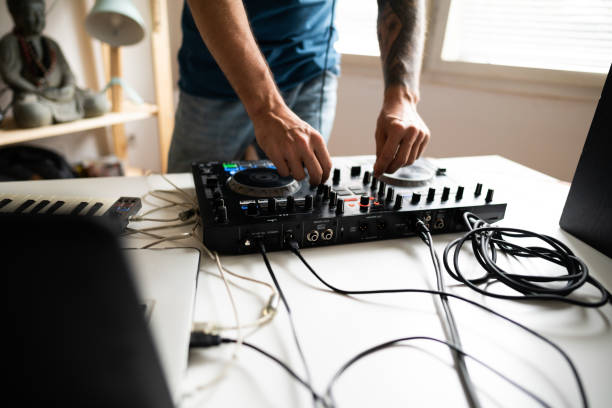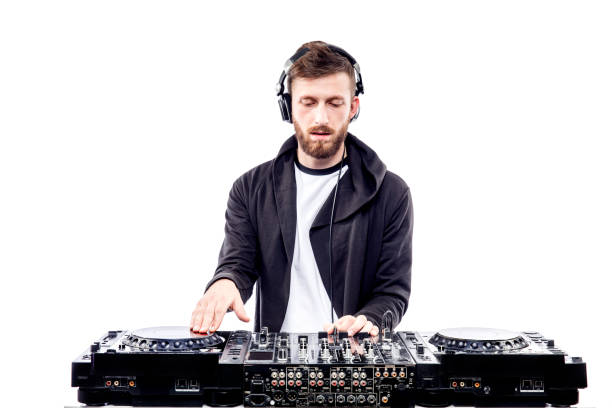
You know that moment when you’re two tracks deep, the energy is building, and suddenly everything turns into a muddy, indistinct soup? Your low end is fighting itself, the clap on the incoming track is stepping on the snare of the outgoing one, and that glorious vocal hook you wanted to tease in is just getting lost. It isn’t your song selection. It isn’t your phrasing. It’s your mids. The most overlooked, abused, and transformative region in the entire frequency spectrum is the middle ground—literally. If you want to master the mix, you have to learn how to kill with kindness, how to carve with surgical precision, and how to create space where none existed before. Welcome to Advanced EQ And Filtering, where we’re throwing out the old “just cut the low end” advice and diving deep into one of the most powerful tools in a DJ’s arsenal: creating space in the mids.
Let’s get real for a second. The midrange is where the soul of a track lives. Vocals, melodies, guitar riffs, synth leads, snare bodies, and the harmonic content of almost every instrument you love—it’s all jostling for real estate between roughly 250 Hz and 2 kHz. When you layer two tracks that both have heavy midrange presence, you get what engineers call “masking.” One track literally covers the other, hiding its details and making the whole blend sound flat, tiny, and amateur. The fix isn’t to just turn one track down—that kills your energy. The fix is to create space in the mids by intentionally cutting frequencies in one track so the other can breathe. This is a mindset shift. You aren’t removing sound; you’re carving a pocket for magic to sit in.
Start with your incoming track. Let’s say you’re mixing a vocal-heavy house tune into a groove that’s already locked in on the floor. Before you bring the new track up, engage your EQ and find the area around 400 Hz to 800 Hz. This is where the vocal’s body and the low-mid warmth of a kick or bass synth can clash. Apply a modest, narrow cut—about 2 to 3 dB, with a Q factor tight enough to not sound honky—right where the outgoing track’s lead instrument or vocal sits. You aren’t gutting the incoming track; you are creating a frequency hole that the outgoing track can occupy. When you bring the fader up, the outgoing track will seem to gently sift through the new one, like smoke moving through a screen. The result is a clean blend that feels intentional, not cluttered.
The real pro move, however, is what you do with the outgoing track. Your instinct might be to leave it alone, or to just high-pass filter the low end. That’s for rookies. To master the mix, you need to apply a complementary cut in the outgoing track’s mids right around the same frequency, but slightly wider, and then slowly restore it as you transition out. Think of it like two dancers swapping a spot on the floor—one moves slightly left, the other moves slightly right, and nobody steps on toes. Use a parametric EQ with a high-pass filter first, then add a gentle bell cut between 1 kHz and 3 kHz on the outgoing track to let the incoming vocal or snare cut through. As you complete the transition and bring the outgoing track down, you slowly sweep that cut back to flat. The audience won’t hear the EQ move; they’ll just feel that the mix got wider, clearer, and more powerful.
This technique is especially crucial when you’re working with tracks that share similar instrumentation, like two piano house records, two D&B rollers with heavy mids, or two classic techno cuts that both have that gritty sawtooth lead. In those situations, you can also use the midrange trick in reverse: boost the incoming track’s mids by 1 to 2 dB while simultaneously cutting the same region on the outgoing track. This creates a sensation of the new track “replacing” the old one while keeping the overall energy constant. It’s the DJ equivalent of a magic trick—the audience thinks the track just sounded good together, but really, you sculpted the space.
Remember that your filter knobs are your friends here, too. A resonant band-pass filter on the outgoing track, sweeping from around 700 Hz upward while you bring the incoming track in with a low-pass filter that’s slowly opening, creates a beautiful midrange crossfade that feels musical and dynamic. You are effectively automating the space between the two songs. No muddy buildup, no harsh clash, just a smooth, professional-sounding transition that would make Frankie Knuckles nod with approval.
The key takeaway? Stop treating the midrange as a problem to avoid. Start treating it like a landscape to be shaped. Every frequency between 200 Hz and 2 kHz is a potential site for conflict or collaboration. By cutting before you bring in, and cutting again on the way out, you create a sonic architecture where each element has its own seat at the table. Your mixes will feel bigger, your transitions will feel smoother, and your audience will feel the difference even if they can’t name it. That’s the difference between a DJ who plays tracks and a DJ who masters the mix. Carve the mids, own the room.