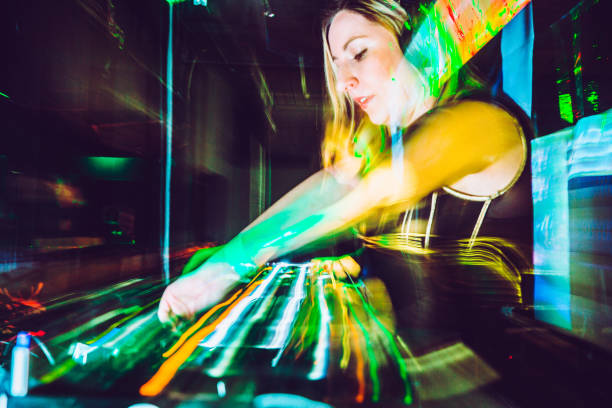
Picture this: you’re locked into a four-hour set at a warehouse in Berlin. The crowd is throbbing, the bass is vibrating through your chest, and your eyes are locked on the decks. But tonight, something’s different. Behind you, the LED wall isn’t just playing a pre-made visualizer or a loop of trippy geometry. It’s alive—morphing, reacting, and breathing in perfect lockstep with every snare roll, every reverb tail, every filter sweep you’re throwing at the mixer. That’s not a VJ hiding in the corner with a laptop. That’s generative visuals synced to audio, and it’s about to flip the entire DJ booth on its head.
If you’ve been anywhere near the DJ community lately, you’ve heard the chatter about AI creeping into the craft. Some purists roll their eyes, muttering about “the art of the mix” being replaced by algorithms. But here at AI In The Booth, we’re not here to gatekeep. We’re here to explore how technology—from Larry Levan’s tape loops to Frankie Knuckles’ drum machines—has always been about expanding what’s possible behind the turntables. And right now, generative visuals synced to audio is the most exciting frontier since the invention of the sync button.
So what exactly are we talking about? Generative visuals are real-time, algorithmically created imagery that reacts to sound. Think of software like TouchDesigner, Resolume Arena, or newer tools like Runway ML and Stable Audio—but tuned specifically for live performance. Instead of a VJ manually triggering clips or playing a pre-rendered video, the software “listens” to the audio waveform and generates unique visual content on the fly. Every kick drum triggers a fractal bloom. Every snare snaps a color shift. Every pad vowel unlocks a new dimension of movement. It’s not canned. It’s not predictable. It’s as alive and improvisational as your mix.
For DJs, this changes everything. We’ve all been there: playing a killer set, vibing with the room, but the visuals are flat or completely disconnected from what you’re doing. Maybe it’s a generic screensaver-style loop. Maybe it’s a projector playing old music videos. Either way, it breaks the trance. Generative visuals close that gap, turning your set into a fully immersive sensory experience. The crowd isn’t just hearing your transitions; they’re seeing them. The energy in the room becomes a feedback loop—you pull a breakdown, the visuals soften into liquid clouds, the crowd breathes deeper, you build back up, and the screen explodes into a kaleidoscope of light that matches the drop.
The tools are getting more accessible by the week. You don’t need to be a coding wizard or a VJ with a decade of experience. Platforms like VJKit, HeavyM, and even Ableton’s integration with Max for Live are putting generative visuals into the hands of working DJs. Some controllers now come with MIDI-mappable visual controls. Some streaming services for DJs like Twitch and Smashcast are seeing creators experiment with AI-generated backgrounds that change based on track mood. And for the gearheads out there, pairing a setup with a Raspberry Pi or a laptop running a lightweight generative engine is cheaper than a new pair of CDJs.
But let’s address the elephant in the booth: is this cheating? Is it “real” DJing? Look, nobody asked if Larry Levan was cheating when he used reel-to-reel tape machines to layer sounds. Nobody asked if Frankie Knuckles was cheating when he used a Roland TR-808 to create his own beats. Wendy Hunt didn’t get questioned for blending disco with early samplers. Every generation of DJs adopts new tools to push the craft forward. Generative visuals are no different. You’re still reading the room. You’re still selecting tracks. You’re still mixing. You’re just painting with a bigger brush.
The future of DJing isn’t just about better sound—it’s about total environment control. Clubs are already catching on. Places like Berghain, Fabric, and even the Brooklyn Mirage have invested in massive LED walls and projection mapping that can handle real-time generative content. Festivals like Sonar and Dekmantel are booking acts that blend audio and visual creation into one live performance. The line between DJ and VJ is dissolving. Soon, the booth might have one person doing it all: mixing, triggering visuals, even controlling the lighting rig through AI-driven systems that learn the crowd’s energy.
Of course, there are challenges. Latency is the enemy—any delay between the audio and the visual breaks the spell. Hardware needs to be reliable. And there’s a learning curve, especially for DJs who’ve never touched a graphics card. But the community is building tutorials, templates, and presets faster than ever. We’re seeing a new hybrid role: the “audio-visual selector” who curates both sound and sight. And that’s exciting.
For the traveling DJ, this also means a lighter rig. Instead of hauling a crate of video gear, you can pack a laptop, a controller, and a subscription to a generative visual platform. Connect to the club’s display system, load up your audio-reactive template, and hit play. The visuals generate themselves based on your set. It’s like having a VJ in the cloud.
So whether you’re spinning house in Ibiza, techno in Detroit, or breakbeat in Bangkok, generative visuals are coming for your booth. Don’t fight it. Learn it. The future of DJing is synced, immersive, and alive. And your next mix deserves to be seen as much as it’s heard.