You know that moment. You’re locked into a mix, sweat beading on your forehead, the crowd is a blur of nodding heads and raised hands, and you feel that perfect sync—the kind where your body moves before your brain even processes the next beat. Then, suddenly, your headphones hit you with a tiny, almost imperceptible delay. The kick drum from your left deck lands a millisecond late against the right one. That wobble? It’s not a cool effect. It’s latency. And in the seamless, fluid world of DJing, latency is the silent assassin of the groove.
We’ve all been there, hunched over a controller, tweaking pitch faders with the precision of a watchmaker, but that lag between your finger’s action and the speaker’s reaction is the ultimate buzzkill. In the future of DJing, especially with the rise of virtual reality clubbing, this issue isn’t just annoying—it’s existential. Because when you’re mixing in a fully immersive digital space, where your hands aren’t touching plastic knobs but tracking in mid-air, and your audience is dancing in their living rooms wearing headsets, even five milliseconds of delay can collapse the entire energy of a set.
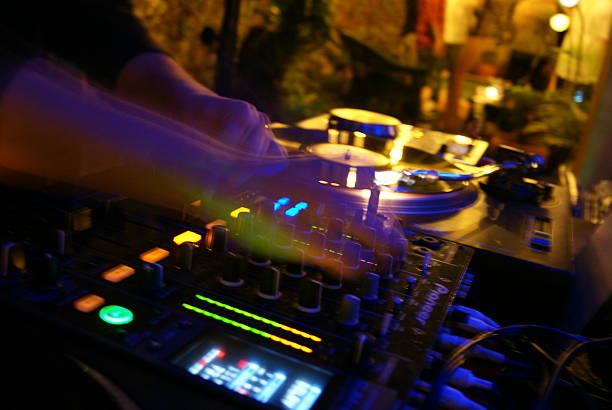
Let’s break this down. In traditional DJing, latency comes from a few places. Your laptop’s audio buffer, the USB connection to your mixer, the software’s internal processing, even the Bluetooth speakers you’re using at a backyard party. Classic rule of thumb: anything above ten milliseconds starts to feel “spongy.” Above twenty, you’re fighting the gear, not flowing with the music. It’s the difference between a tight, punchy backspin and a sloppy, rubbery womp that makes you look like you’ve never touched a pair of Technics in your life. For vinyl diehards spinning real wax, latency is almost non-existent because the signal path is purely analog. But for the rest of us living in a cloud-based, streaming, controller-heavy world, latency is the digital ghost we’re constantly trying to exorcise.
Now imagine virtual reality clubbing. The future is already here: platforms like Tribe XR and Wave let you stand in a photorealistic club, cue tracks off virtual CDJs, and mix for an audience of avatars. The promise is wild: no more dragging heavy cases through airports, no more sound checks in garbage spaces, and global audiences you can actually see dancing. But here’s the ugly truth—VR introduces two massive latency vectors. First, the processing power needed to render 3D environments and hand tracking can add buffer delays far beyond what a standard laptop DJ setup handles. Second, network latency when streaming your mix to remote dancers or syncing with other DJs across continents creates a jittery experience that kills the “lock.” You’ll be riding a filter sweep, the crowd’s avatars should be going nuts, but instead, they’re doing that robotic, delayed clap thing that screams “my Wi-Fi hates me.”
This isn’t just a tech hurdle; it’s a culture killer. The core of DJing—from Larry Levan’s endless edits at the Paradise Garage to Frankie Knuckles’ soulful lifts at the Warehouse, to Wendy Hunt’s deep-house grooves—was always about the connection between the DJ’s physical intuition and the dance floor’s collective body. The groove is not a data packet; it’s a vibe that travels faster than electrons. If we lose that micro-timing, we lose what separates a DJ from an algorithm.
The industry knows this, so the race is on. Next-gen VR headsets are ditching wireless streaming for direct wired connections for audio. Software like Serato and Rekordbox are implementing “low-latency monitoring” modes that prioritize real-time output over visual effects. And some forward-thinking clubs are experimenting with haptic feedback gloves, so the DJ can physically “feel” the beat beneath their fingers, bypassing visual lag entirely. The future of DJing will hinge on solving this riddle: how to make a digital environment feel as immediate as a needle dropping into a vinyl groove.
For now, if you’re a traveling DJ dreaming of booking that bucket-list club in Berlin or Tokyo, keep your setup tight. Hardwire everything. Ditch Bluetooth. Turn off Wi-Fi when you mix. And when you step into that VR headset, demand gear that respects the latency threshold. Because the groove is the whole point. And nothing—not even the metaverse—should be allowed to kill it.