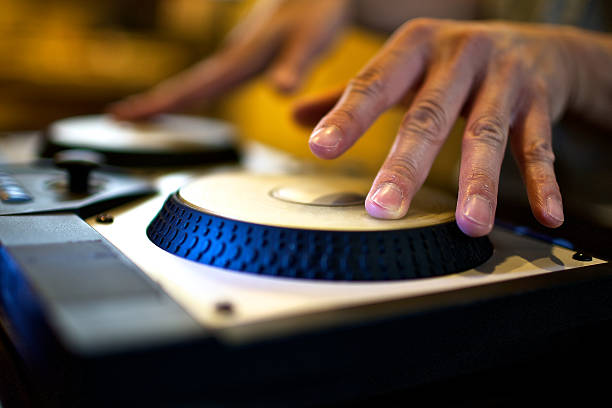
You know that moment when you’re in the middle of a set, the crowd is locked in, and someone walks up to the booth and asks, “What’s that track? It’s so… floaty.” And you just nod, because yeah, it is floaty—but you’re also realizing that “floaty” is doing a lot of heavy lifting. That’s where we come in. Welcome to the world of descriptive sound adjectives, where your vocabulary becomes as lush and layered as the pads you’re cueing up. Because let’s be real: if you can’t articulate why a track makes you feel like you’re drifting through a cloud, how are you supposed to vibe with your fellow heads? Let’s break down the lingo that turns a simple “this sounds good” into a full conversation starter.
First up, let’s talk about “lush pads.” In DJ-speak, a pad isn’t something you use to sleep on—it’s a sustained sound, usually synth-based, that fills the frequency spectrum like a warm blanket. Think of it as the sonic equivalent of a cashmere hoodie. When you hear a track with lush pads, you’re hearing long, evolving chords that wash over you. They’re not percussive; they’re atmospheric. They create space. And when those pads are “lush,” they’re layered with harmonic richness, maybe a touch of reverb, maybe a slow filter sweep. They make you want to close your eyes and sway, not jump. That’s the “floaty feels” territory.
Now, “floaty” itself is a vibe adjective. It describes the sensation that the music is carrying you, lifting you off the dancefloor even if your feet are still planted. Floaty tracks often have a slower, dreamlike tempo—think 110-120 BPM, deep house or ambient techno. The kick drum is present but not pounding. The hi-hats are soft, maybe swung. The pads and textures do the heavy lifting. When you say a track is floaty, you’re saying it’s weightless, ethereal, and maybe a little melancholic in a beautiful way. It’s the kind of track you play during golden hour at a festival, or when the afterparty has mellowed into a pillow fort of good vibes.
But how do you get more specific? That’s where the descriptive adjectives come in. You might hear a pad described as “almost holographic,” meaning it shimmers and shifts as if it’s three-dimensional. Or “satiny,” meaning it’s smooth and glossy, no rough edges. “Breathy” pads have a vocal-like quality, as if the synth is sighing. “Velvet” is another one—soft, dark, and sumptuous. And if a pad is “lush” but also a little “grungy,” that means it has some texture, maybe a bit of distortion or a lo-fi tape warmth. It’s the difference between a clean synth pad and one that feels like it’s been lived in.
Then there’s the opposite end: if a track is “airy” instead of floaty, it has more space between the elements. Airy means the high end is sparkling, the reverb tail is long, and there’s a sense of openness. If a pad is “thin,” that’s not always a bad thing—it can mean it’s delicate, fragile, and cuts through without overwhelming. But “thin” can also be a polite way of saying it lacks body. Similarly, “dense” pads are thick, almost heavy, like a wool sweater on a cold night. You can feel them in your chest.
Mastering this language isn’t just about sounding smart in the booth—it’s about connecting with your audience and your peers. When you describe a track as having “lush pads that give me floaty feels,” you’re painting a picture. You’re saying, “This is a song that exists in a soft, faded dimension.” And when you can do that, you become more than just a DJ who presses play. You become a curator of moods, a translator of sound into emotion.
So next time you’re digging through your crate or scrolling through a streaming playlist, let your ears guide your adjectives. Is that track lush or just loud? Floaty or just slow? Silky or stiff? The more you practice, the more your vocabulary grows—and the more your sets will resonate. Because the best DJs don’t just play music. They speak it.