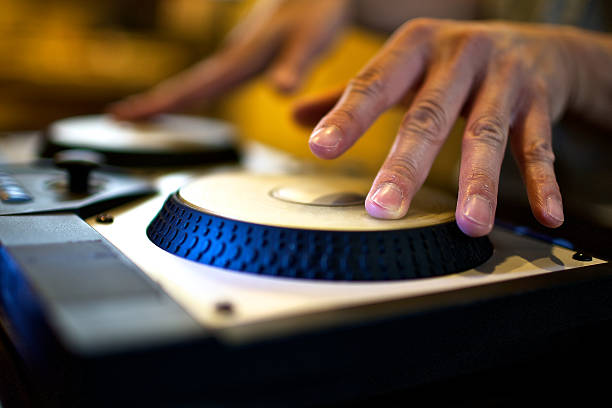
You know that moment when you’re in the middle of a set, the floor is locked in, and you feel that drop creeping up like a wave about to break. Your hands hover over the decks, and the choice is yours: do you let the track play out like everyone expects, or do you chop it, loop it, and twist it into something nobody saw coming? That’s where manual in/out loop agility separates the DJ who plays songs from the DJ who builds worlds. This isn’t just a technical trick. It’s a mindset. It’s the difference between being a jukebox and being a sculptor of sound.
Let’s get real about what loop agility actually means in practice. Most DJs know how to hit the loop button. That’s not the flex. The flex is knowing when to grab a loop, where to set your in and out points on the fly, and how to ride that loop like a wave until you decide to crash it or let it breathe into the next track. Manual loop control—no auto quantize, no cheat codes—forces you to feel the phrasing in your bones. You’re not just counting bars; you’re listening for the subtle tension in the hi-hat, the weight of the kick against the snare, the way the vocalist holds a breath before the chorus drops. That’s the stuff that makes a room lean in.
Here’s how it works when you’re in the heat of a mix. You’ve got a track playing that’s building toward a peak, but you want to stretch that tension another sixteen bars. Instead of letting the track auto-loop on a perfect phrase, you manually set your in point just as the energy swells—maybe right after the build-up snare roll, before the main hook smashes in. Then you ride that loop, bringing in elements from the incoming track, teasing the crowd with the promise of release. The loop becomes your canvas. Every time the phrase repeats, you can tweak the EQ, add a filter sweep, drop in a vocal snippet from another track. You’re not stuck in a repetitive prison; you’re dancing inside the moment. When you finally punch out of the loop on the very first beat of the next section, the crowd doesn’t just hear a transition—they feel a release.
But here’s the part that a lot of DJs sleep on: manual loop agility is as much about your ears as it is about your fingers. You have to develop that internal clock that knows when a loop is overstaying its welcome. A tight four-bar loop can feel hypnotic for eight repetitions. After twelve, it starts to feel like a broken record. After sixteen, people are checking their phones. The pros know to let go before the magic wears off. They also know that an out loop—where you release the loop at an unexpected moment, like halfway through a vocal phrase—can feel more satisfying than a perfectly quantized drop. It’s like landing on the backbeat instead of the downbeat. It keeps the crowd guessing, and that anticipation is pure energy.
This skill connects directly to the history of our craft. Think about Larry Levan at the Paradise Garage, working those reel-to-reel tapes before digital loops existed. He didn’t have a “loop” button. He had to physically ride the faders, cue up sections, and create extended grooves by hand. Frankie Knuckles did the same in Chicago, using edits and tape loops to stretch a drum break into a ten-minute journey. Wendy Hunt, the unsung pioneer of early NYC club culture, knew that the loop wasn’t just a tool—it was a gateway. These trailblazers understood that manual control over the loop was the closest you could get to breathing inside the machine. When you grab a loop with your hands, you’re not just operating gear. You’re continuing a tradition of tactile rebellion against the predictable.
So how do you get better at it? Start with the basics. Pick a track you know inside out, something with a clear eight-bar phrase structure. Practice setting your in point manually on the fly, without staring at the waveform. Then ride it for four repetitions, then six, then eight. Pay attention to how the loop feels different each time. Then practice your out point: release the loop on the “one” of the fifth bar, then try releasing it on the “three” of the third bar. Notice how the release point changes the energy. Then start layering in loops from the incoming track, swapping between them while keeping the phrasing aligned. If you can do this with your eyes closed—relying on your ears and your memory of the track’s structure—you’re moving from technical skill into artistic instinct.
The real secret? Manual loop agility isn’t about being perfect. It’s about being present. When you’re riding a loop you set by hand, you’re in a conversation with the track and the crowd. You’re saying, “I’m here, right now, with you.” That’s the difference between a mix that sounds good and a mix that transforms the room. One loop at a time.