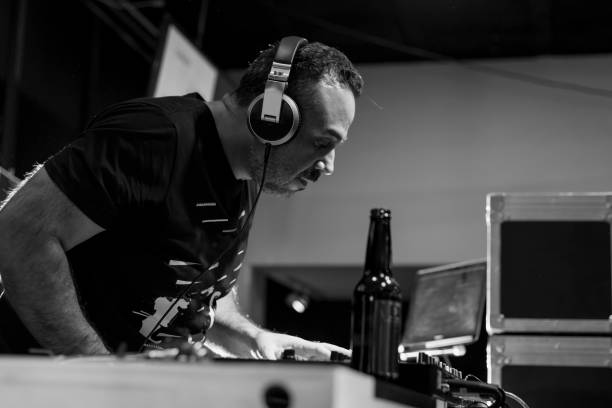
You’re in the booth, two in the morning, the floor is a sweaty blur of bodies moving in lockstep with your every nudge. You’ve got one hand on the pitch fader, the other reaching for a filter knob, and your gut is telling you that the incoming track needs to slam in a half beat early, even though the waveform on your laptop looks nervous about it. You let that gut win. You push it. The crowd roars its approval. That moment—that tiny, risky, gloriously human miscalculation—is the entire point of DJing. And as artificial intelligence starts creeping into our craft, from auto-sync algorithms to AI-generated setlists, the question everyone’s whispering behind their NXS2s is this: how do we preserve the beautiful, chaotic imperfection that makes this art form breathe?
Let’s be real for a second. The tools have always evolved. Larry Levan didn’t have Traktor, Frankie Knuckles didn’t have cloud storage, and Wendy Hunt was laying down foundational grooves with turntables that would make a modern hip-hop DJ weep with gratitude for a Phase remote. Every generation of DJs has had to ask what part of the craft is sacred and what part is just noise. But AI is different. It’s not a better turntable or a more stable beatgrid. It’s a ghost in the machine that can mix for you, pick tracks for you, and theoretically build a perfect night where nothing ever goes wrong. And that’s exactly why we need to fight for the wrong.
Here’s the uncomfortable truth: a perfect set is a boring set. The magic doesn’t come from seamless transitions that sound like one continuous 130 BPM track. The magic comes from the moment your brain scrambles when you realize the crowd isn’t feeling the break, so you slam the crossfader and drop a bootleg acapella over a completely different key, and somehow it works. That’s not a feature you can train a model on. That’s the glorious human failure that makes a night memorable. AI can learn harmony, tempo, and energy curves, but it can’t learn the feeling in your chest when you see that one person in the front row finally smile after a long week.
DJ culture has always been about translation—translating the energy of a room into a sound, translating your own mood into a BPM, translating the history of house and techno and disco into a moment that didn’t exist ten seconds before. That translation is inherently imperfect. It’s you, the DJ, processing a hundred signals at once: the drunk guy asking for “Freebird,” the bass that’s rattling the booth, the memory of your favorite Frankie Knuckles set from an old YouTube VHS rip, the fact that you spilled Red Bull on your mixer and the low EQ is sticky. That stickiness is part of the art. It’s what separates a DJ from a playlist generator.
The future isn’t about rejecting AI outright. That would be like a vinyl purist refusing to use a CDJ, which is a conversation we’ve already had and mostly gotten over. The real move is to treat AI like a high-end audio technician or a really smart intern—it can help you prep, organize, and even suggest, but it should never be trusted with the final call. Use it to find key-compatible tracks in your library faster. Use it to analyze your set history and spot patterns. But when it’s time to actually stand in front of a crowd and feel the room, you need to mute the algorithm and trust your instincts. The human ear, connected to a human heart, will always catch a nuance that a software model misses.
Preserving human imperfection also means protecting the social rituals that come with DJing. The handshake after a back-to-back session where you both missed the drop but laughed it off. The stumble as you lean over to grab a record from a milk crate and knock over your water bottle, then turn that stumble into a drop. The nervous breath before you queue up a track you’ve never played out before, because you believe in it even if the AI analysis says it’s a “52% crowd approval probability.” Those moments are the soul of the booth. They cannot be engineered.
So as you build your own journey—whether you’re just starting with a controller in your bedroom or you’re packing a flight case for a bucket-list club in Berlin or Tokyo—hold onto the grit. Let AI handle the boring math. But every time you fumble a transition and laugh it off, every time you take a risk on a weird B-side because the vibes are right, you’re preserving what made Larry Levan, Frankie Knuckles, and Wendy Hunt legends. They weren’t perfect. They were human. And that imperfection is the one thing the machines can’t take from you.