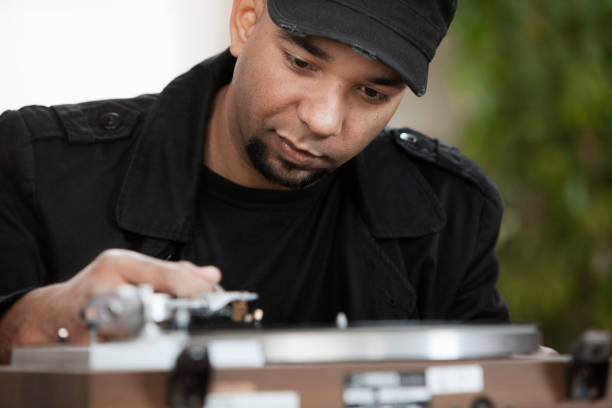
If you’ve ever watched a veteran DJ drop a track with surgical precision—no drift, no awkward silence, just a seamless blend that makes the room gasp—you’ve witnessed the quiet magic of a rotating cup mechanism. It’s not flashy. It doesn’t end up on Instagram reels. But for anyone serious about beatmatching, this piece of engineering is as essential as the Holy Grail Headphones you’re wearing over your ears. Let’s get into why this gear-up essential deserves a spot in your mental toolkit.
First, a quick reality check. Most modern DJs grew up on sync buttons, BPM readouts, and waveforms that dance across screens like fireflies. That’s fine—there’s no shame in using the tools you have. But rotating cup mechanisms belong to a different lineage: the tactile, feel-based world where your fingers, not your eyes, do the heavy lifting. These are the physical components inside analog turntables or high-end controllers that let you spin a platter backward, nudge a pitch fader, and lock into tempo without staring at a display. Think of them as the mechanical soul of DJing.
So what actually is a rotating cup mechanism? In turntables like the Technics SL-1200 series—the gold standard since the 1970s—the platter sits on a spindle. That spindle is housed inside a rotating cup, which is essentially a precision bearing assembly. When you apply slight pressure to the platter, the cup rotates with it, reducing friction and allowing for ultra-smooth pitch changes. This is how DJs do that subtle “nudge” to sync two tracks by ear. Without a well-maintained cup, you’d get jerky, unreliable adjustments that make beatmatching feel like trying to parallel park a boat.
The beauty of rotating cup mechanisms is that they reward touch. You don’t need to see a waveform to know you’re off by a hair. You feel it. The slight resistance, the tiny wobble in your palm, the way the platter slows or speeds up as your finger edges the pitch slider. This haptic feedback is what separates a mix that sounds good from one that feels alive. For DJs who grew up on digital controllers, it’s a humbling skill to master. But once you do, you start to understand why Larry Levan or Frankie Knuckles could hold a dancefloor for hours without ever looking at a screen. They trusted their hands.
Now, the caveat. Not all rotating cup mechanisms are created equal. On budget turntables, you get plastic cups that wear down fast, causing “wow and flutter” (that warble you hear when a record’s speed isn’t stable). On high-end gear like the aforementioned Technics, the cups are machined metal with sealed bearings. They last decades if you oil them right. If you’re shopping for turntables to practice beatmatching, look for direct-drive models with metal cups. Belt-drive turntables use a different system—belts stretch and slip, making pitch precision a nightmare. Rotating cup mechanisms give you that instant, reliable response that lets you lock in a mix without second-guessing.
For DJs using modern hybrid controllers like the Pioneer DJM-S11 or Rane Seventy-Two, you might think rotating cups don’t apply. Wrong. Even digital platters have moving parts underneath the touch-sensitive surface. Motorized platters (like on the Denon SC6000 or Technics SL-1200MK7) still use a rotating cup assembly to mimic the feel of vinyl. So whether you’re spinning actual records or jog wheels, the same principles hold. A sticky, misaligned cup will ruin your flow. A well-maintained one makes cueing a quiet, satisfying ritual.
Maintenance tip: every few months, give your turntable’s rotating cup a drop of synthetic oil (not WD-40, which attracts dust). Spin the platter by hand to distribute it. Clean the spindle with a lint-free cloth. This isn’t glamorous, but it’s the difference between a gear-up session that feels like a chore and one that feels like you’re driving a luxury car. Also, if you’re a traveling DJ, know that temperature changes can warp cheap cups. Keep your decks in padded cases.
One more thing: rotating cup mechanisms are a dying art in the age of digital sync. But that’s exactly why they matter. They remind you that DJing isn’t just about selecting tracks—it’s about physical connection to the music. When you learn to cue by feel, your blends become more intuitive. You start to hear the spaces between beats instead of just the grid. That’s the kind of knowledge that separates a playlist DJ from a true performer.
So next time you’re looking at your gear, take a second to appreciate the rotating cup under your platter. It’s small. It’s hidden. It’s probably dusty. But it’s the reason you can trust your hands in the dark, on a packed floor, with nothing but a pair of Holy Grail Headphones and a beat that needs finding. That’s not just gear. That’s the secret sauce.