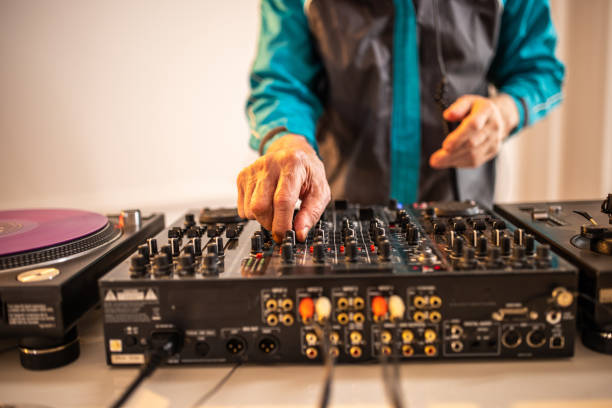
You’ve just dropped a track that shakes the subs, the crowd is locked in, and you’re about to bring in that immersive, 360-degree vocal flip. But in your cans? It sounds like the song is getting lost in a funhouse. Welcome to the new frontier of DJing—spatial audio mixing—and the headphone problems nobody warned you about. As we pivot from stereo to immersive formats, DJs are discovering that the future of beat matching isn’t just about tempo and phrasing anymore; it’s about translating three-dimensional sound through two tiny drivers strapped to your skull.
Spatial audio, whether it’s Dolby Atmos, Sony 360 Reality Audio, or Auro-3D, promises listeners a bubble of sound where instruments float around them like ghosts. But for DJs, this is a double-edged sword. You’re no longer mixing a flat left-right stereo field. You’re trying to blend songs where the snare might be coming from behind your right ear in Track A, and from above you in Track B. The first challenge is simple: your standard DJ headphones weren’t designed for this. They’re built for isolation and punch, not for simulating a sphere of audio. When you cue a spatial mix, your brain expects spatial cues—reverb tails that wrap around, side-fills that drift—but gets them crushed into a narrow stereo image. The result? You’ll hear a muddy, disorienting mess that makes cueing a transition feel like trying to catch smoke with chopsticks.
Then comes the latency nightmare. Spatial audio processing, even in the best decoder software, introduces delay. When you’re beatmatching by ear, that tiny lag—just milliseconds—can throw off your entire flow. You might think you’re locked in, but when you drop the fader, the crowd hears a phasey, comb-filtered trainwreck. This isn’t a hardware issue alone; it’s a format issue. Most DJ controllers and mixers still route audio through traditional stereo buses. To mix spatial formats properly, you’d need a dedicated decoder built into your rig—something that currently exists more in high-end studios than in any booth at Berghain. The industry is playing catch-up, and right now, the DJ is the beta tester.
But let’s talk about the biggest headphone challenge of all: the loss of the “mono check.“ Every veteran DJ knows the value of flipping your headphones to mono to check phase alignment and ensure your mix doesn’t fall apart on a club system’s single sub. Spatial audio throws that out the window. In an immersive mix, instruments are placed using binaural cues and object-based panning. A mono sum squeezes that spatial magic into a flat, dull blob. You can’t reliably check if your low-end is clean or if your hats are phasing because the spatial algorithm re-interprets the mono signal in a way that is completely different from what you actually hear in the room. It’s like tasting a cake recipe by eating the raw flour—you’re not even close to the final experience.
So where does this leave the future of DJing? For now, the smartest approach is hybrid. You don’t have to abandon your stereo master, but you can experiment with spatial headphone cueing using tools like the Waves Nx plugin or Apple’s Spatial Audio renderer. Some forward-thinking DJs are using two pairs of headphones: one closed-back for isolated stereo cueing, and one open-back with binaural rendering to preview spatial placement. This isn’t elegant, but it works. The problem is that clubs and festivals are slow to adopt immersive PA systems, so your headphone mix might sound amazing on your laptop but fall apart on a Funktion-One rig. The real solution lies in hardware manufacturers like Pioneer DJ and RANE building spatial-aware cue channels that can decode Atmos or 360RA directly into the booth monitor without latency.
Ultimately, spatial audio is inevitable. When you hear a track like Beyoncé’s Break My Soul in an immersive mix, you realize the potential: vocals that swirl, bass that breathes. But as DJs, we are the bridge between a producer’s vision and a dancer’s body. If our headphones can’t faithfully render that vision, we’re flying blind. The next decade will be about rethinking cueing itself—maybe we’ll use haptic feedback or visual waveforms to replace our ears’ spatial confusion. Until then, every DJ mixing spatial audio is a pioneer, fighting phase, latency, and the limits of plastic earcups. The future sounds incredible. But your headphones might need an upgrade first.