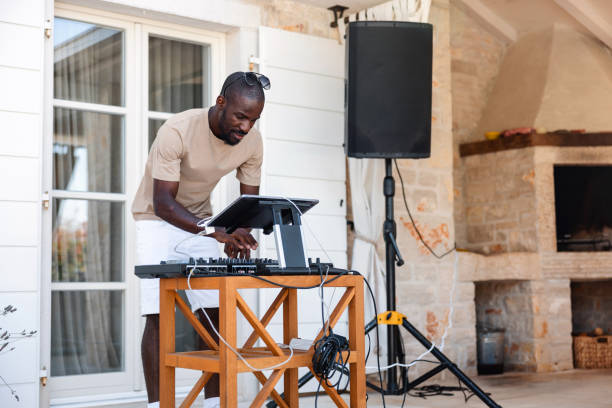
So you’ve got the controller, you’ve got the headphones, and you’ve finally cleared a corner of your bedroom or apartment living room to call your own DJ booth. Welcome to the club. But here’s the thing nobody tells you when you’re staring at a brand new pair of monitors in a space barely bigger than a walk-in closet: physics doesn’t care about your budget. In a tiny room, speaker placement isn’t just about aesthetics or cable management—it’s the difference between hearing your mix clearly and fighting a muddy, bass-heavy mess that makes every transition feel like guesswork. This is DJ Life 101, and we’re talking about the bare minimum setup that actually works.
First, let’s get one thing straight: your speakers and your turntables or controller need to be friends, not enemies. In a small room, the biggest mistake beginners make is shoving monitors right up against the wall. I get it—you’ve got a desk, a bed, maybe a bookshelf, and every inch counts. But when a speaker is too close to a wall, the low frequencies bounce right back at you, creating a boomy, exaggerated bass that tricks your ears into thinking your levels are correct when they’re actually way off. Suddenly your kick drum sounds like a wrestling match, and the floor is literally vibrating under your feet. That’s not a vibe—that’s a mixing disaster waiting to happen. The rule of thumb for any room, especially a small one, is to pull your speakers at least six to twelve inches away from the wall behind them. If you can manage a foot, even better. This gives the rear port (the hole on the back of most monitors) room to breathe and stops that low-end from getting trapped.
Now, let’s talk about your listening position. You’ve probably heard the phrase “equilateral triangle” thrown around in audiophile circles, and yeah, it sounds like math homework. But here’s the simple version: imagine your head and your two speakers forming a perfect triangle. Your monitors should be angled so they point directly at your ears, not straight ahead into the void. In cramped quarters, this means you might have to scoot your chair closer to the desk or even pull your gear to the edge of your surface. It’s worth the awkward shuffle. If your speakers are too far apart for the room, you lose the stereo image; too close, and everything collapses into mono. Find that sweet spot where you can close your eyes and hear the hi-hats panning left, the claps panned right, and the bass locked in the center. That clarity is what separates a bedroom DJ from someone who can actually build a set that translates to a big system.
Acoustic treatment sounds like a luxury you can’t afford, but it’s actually the cheapest upgrade you can make in a tiny room. No, you don’t need foam panels covering every wall like a recording studio. Start with the basics: a rug on a hardwood floor kills reflections that make your highs sound harsh, and a cheap pair of curtains over a bare window stops glass from turning your room into a reverb chamber. If you’re really pinched for space, throw a pile of clothes or a duffel bag in the corner behind you—it absorbs stray bass frequencies that cause that “boxy” sound. The goal here isn’t perfection; it’s reduction of the worst offenders. Your ears will thank you within the first five minutes of mixing.
Here’s a quick reality check that every tiny-room DJ needs to hear: subwoofers are not your friend. I know, I know—you want to feel the drop in your chest like you’re at a club. But in a small, untreated room, a subwoofer is like putting a bull in a china shop. It will excite every resonant frequency in the space, making your bass unpredictable and your meters useless. Stick with nearfield monitors, which are designed for close listening. The JBL 305P MkII, the KRK Rokit 5, or even the budget-friendly PreSonus Eris 3.5 are all solid choices that give you honest sound without rattling your landlord’s walls. If you absolutely need more low end, buy a pair of good headphones—like the Audio-Technica ATH-M50x or the Beyerdynamic DT 770 Pro—and use them to check your bass levels before you flip the speakers back on.
Finally, embrace the fact that your tiny room has a personality. Every space has a “sweet spot” and a “dead zone.” Walk around your room while playing a track you know well. Where does the bass sound clearest? Where does the high end get harsh? That’s your listening position. Tweak your speaker angle by a degree or two, adjust your chair height, and don’t be afraid to put your speakers on foam isolation pads or even a stack of books to get them ear-level. The legendary DJs who started in cramped bedrooms—think Frankie Knuckles in his Chicago basement or Larry Levan in his tiny New York apartment—didn’t have perfect acoustics. They learned to work with what they had. You can too.
So here’s the bottom line: speaker placement in a tiny room isn’t rocket science, but it’s the most overlooked step in the bare minimum setup. Pull your monitors off the wall, create that equilateral triangle, absorb the worst reflections, skip the subwoofer, and listen to your room. Do that, and you’ll actually hear what you’re mixing. And hearing what you’re mixing? That’s the whole point of DJ Life 101. Now go practice.