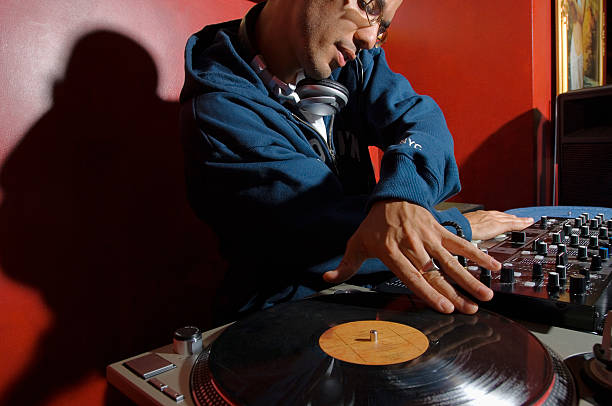
You know that moment. The dancefloor is locked in, bodies moving as one, the energy is a physical thing you could almost taste. Then it happens. A transition that feels less like a seamless bridge and more like a car hitting a wall at eighty miles an hour. The music stutters, the phrasing collapses into chaos, and the crowd’s collective vibe shatters into a confused pause. In DJ lingo, we call this a trainwreck. And if you’ve ever been behind the decks, you’ve probably caused at least one. It’s a rite of passage, a scar, and a lesson all rolled into one ugly, screeching sound.
But what exactly is a trainwreck? It’s not just a mistake. A trainwreck is a specific kind of failure in beatmatching and phrase alignment. It happens when two tracks are playing at incompatible tempos, or when their downbeats are so far off that they create a dissonant, rhythmically jarring mess. Think of it like two trains running on the same track but at different speeds, heading straight for each other. The result is a collision of kicks, snares, and hi-hats that sounds like a broken robot having a tantrum. In the old days, when we relied on vinyl and our ears, a trainwreck was almost inevitable for beginners. You’d be nudging the platter, sweating under the booth lights, and suddenly the room would groan. You’d feel that collective sigh from the dancefloor, and you’d know: you just derailed the night.
This term has survived the transition from turntables to CDJs to laptop controllers because the trauma is universal. Even with sync buttons and BPM grids, a trainwreck can still happen if you’re not paying attention to phrasing. You might have two tracks perfectly matched in tempo, but if you drop a vocal chorus on top of another chorus, or if you bring in a breakdown when the crowd is expecting a drop, the energy can still collapse. It’s less about the technical beatmatch and more about the musical sense. A trainwreck is a failure of flow, a violation of the unspoken contract between the DJ and the dancers.
For the average club-goer, a trainwreck might just sound like “bad mixing” or “that DJ sucks.” But for those of us who speak the language, it’s a specific term with its own gravity. It carries a sense of embarrassment and also a weird badge of honor. Every great DJ has a trainwreck story. Larry Levan, the legendary master of the Paradise Garage, was known for his chaotic, high-risk style. He would sometimes push tracks so hard that they nearly fell apart, but his skill was in recovering before the disaster fully hit. He understood that the thrill of the dancefloor often lives on the edge of disaster. A perfect trainwreck avoidance is what makes a DJ great. The ability to hear the crash coming and weave the beat back together before anyone notices is called “saving it.” And the best saves become legendary.
On the dancefloor, you feel a trainwreck in your gut. The bass goes off-grid, the dancers lose their step, and for a brief second, a silence or a wrong note cuts through like a foghorn. Sometimes the DJ will try to cover it with a filter sweep or a quick cut, but the damage is done. The crowd’s trust is broken. In the world of DJ Lingo, the term also gets used metaphorically. A “trainwreck set” might not mean the DJ ruined every transition, but that the track selection was a mess, the energy was inconsistent, or the vibes were just off. It’s the opposite of a “journey.” A trainwreck is a derailment.
For the aspiring DJ reading this on a site dedicated to the craft—whether you’re browsing bucket-list clubs in Europe or studying the history from Frankie Knuckles to Wendy Hunt—know this: trainwrecks are your teachers. They teach you to listen, not just look at waveforms. They teach you to trust your ears over your eyes. They remind you that the dancefloor is a living thing, and you are its pilot. The next time you’re in the booth and you feel that skip, that stumble, that cold sweat, don’t panic. Breathe. Nudge the pitch. Wait for the phrasing. Everyone has derailed. The question is whether you can get the train back on the tracks before the crowd walks away.
Because at the end of the night, the dancefloor remembers the energy, not the error. But you? You’ll remember that trainwreck forever. And that’s okay. It’s part of speaking the language.