Your visual aesthetic is the first drop before the first drop. Before anyone hears your set, they see your flyer, your grid, your fit, your booth, your logo. For a DJ, that look isn’t just decoration. It’s a translation of your sound into something people can recognize in half a second. If your tracks are deep, smoky, and late-night, maybe your visuals shouldn’t be neon smiley faces. If you play hyperpop, pastel chaos might be exactly right. The goal isn’t to be the loudest. It’s to be unmistakable.
Start with your sonic identity. Write down five words that describe your sets. Warm, punchy, celestial, moody, playful. Then turn those into visual adjectives. Warm could mean amber lighting, film grain, analog textures. Punchy could mean bold type, high contrast, sharp cuts. Celestial could mean chrome, stars, soft gradients. Mood boards help. Save album covers, movie stills, fashion editorials, club flyers, textures, fonts, and color combos. Don’t copy one source. Steal like a DJ blends: take a little from here, a little from there, then flip it until it feels like you.
Next, define the core assets. You need a logo or wordmark that works tiny on a story post and huge on a banner. You need two fonts, maybe one loud display font and one clean sans for details. You need a color palette: two main colors and one accent. That’s it. More than that gets messy. A consistent palette makes your flyers, cover art, merch, and social posts feel related even when different designers make them. Keep a folder with your logo in different formats, your hex codes, and your fonts. Call it your brand kit. It sounds corporate, but it saves you when a promoter asks for assets an hour before doors.
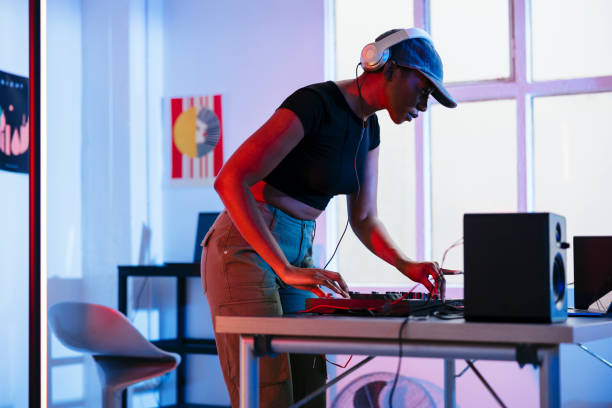
Your fit is part of the aesthetic too. Clothing should feel like you but also work for the job. You’re bending over decks, plugging cables, sweating under lights, standing for hours. Comfort is not a betrayal of style. Build around a silhouette that reads onstage: oversized, tailored, technical, rave, vintage, streetwear, whatever. Add a signature piece. Maybe it’s a cap, a chain, a pair of futuristic shades, a vintage racing jacket, or fresh white sneakers. One recognizable detail goes further than a full costume. Also think about photos. If your outfit only works in dark rooms, it won’t pop on a promoter’s carousel.
Stage and booth visuals matter more than ever. A simple setup can look intentional: clean cable management, matching slipmats, a laptop skin, a small light, a banner with your logo. If you use visuals, sync them to your energy. Glitchy loops for chaotic sets, slow gradients for deep ones. Don’t let visuals distract from the music. The crowd came for the sound. Your aesthetic should frame it, not fight it.
Your content is the ongoing proof of your brand. You don’t need a professional photographer every week, but you do need a point of view. Pick an editing style and stay close to it. Maybe it’s flash photography, grainy film emulation, high-contrast black and white, or clean daylight. Show your hands on the decks, the crowd, the city, the preparation, the quiet moments. Memes are fine if they match your voice. Trends are fine if you remix them instead of just reposting them. The algorithm rewards consistency, but your real fans reward recognition.
Respect the culture behind the aesthetics you borrow. House, techno, disco, and club culture were built by Black and queer communities, by pioneers like Larry Levan, Frankie Knuckles, and Wendy Hunt. If you reference ballroom, vogue, warehouse rave, or garage, know the history. Credit the originators. Don’t treat someone’s lived culture as a costume. The most powerful visual identity is one that knows where it comes from and adds something honest.
You don’t need a huge budget. Thrift stores, local designers, small artists, and DIY can go further than fast fashion. One great jacket, a clean tee with your logo, custom stickers, and good lighting can carry a whole era. Your aesthetic will evolve as your sound evolves. Let it. Rebrand when the old look stops fitting. Archive the old chapters. The point isn’t to lock yourself in. It’s to build a world people want to step into when they see your name on the flyer.