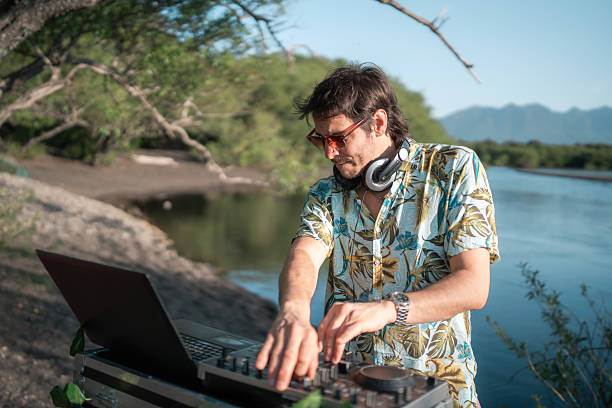
Immersive audio formats are not just a flex for audiophiles. They’re a full-on shift in how sound gets designed, mixed, and felt. Instead of treating a track like two channels of left and right, spatial formats like Dolby Atmos, Sony 360 Reality Audio, ambisonics, L-ISA, and d&b Soundscape treat every element as an object with a position in three-dimensional space. A vocal can float a foot above your head. A hi-hat can orbit the room. A bassline can sit low and wide, hugging your ribs. For DJs, that’s not just a new toy. It’s a new instrument. And it’s about to change everything from how you prep a set to how a crowd loses its mind at 2 a.m.
Right now, most DJ setups are stereo. You’ve got two channels, maybe some effects, and a room that shapes the sound whether you like it or not. Immersive audio adds height, depth, and movement. Object-based mixing means the DJ or producer decides where a sound lives, not just how loud it is. With stem separation and real-time processing, you can pull apart a track into vocals, drums, bass, and melody, then throw those pieces around the room like confetti. Software like Ableton Live, Max/MSP, TouchDesigner, and Resolume is already being used to build these spaces. Controllers are catching up too: joysticks, touchpads, motion sensors, and MIDI mapping that lets you fling a synth stab from the front left to the back right without touching a fader.
In a club, that means the dancefloor stops being a single blob facing the booth. It becomes zones. Maybe the front row gets a dry, punchy kick while the back wall gets a washed-out reverb tail. Maybe a riser circles the room before the drop hits from every speaker at once. That’s the kind of moment that makes people pull out their phones, sure, but it also makes them stay. Gen Z and younger millennials grew up with video games, VR, and headphones that simulate 360-degree sound. They expect experiences, not just tracks. Spatial audio turns a DJ set into an IRL environment you can walk through. You don’t just hear the set. You’re inside it.
The technique side is where it gets spicy. Beatmatching and phrasing still matter, but now you’re also mixing in space. You have to think about elevation, distance, and motion. A filter sweep can move from left to right. A vocal can drift behind the crowd and then snap forward. Your EQ becomes more like spatial EQ, carving out room for objects so they don’t clash. Monitoring gets weird too. In-ear monitors with binaural mixes can help you hear the spatial image without the room muddying it. But you also need to check how it translates on a phone speaker, a mono club system, and a pair of AirPods. The best spatial DJs will be the ones who know when to hold back. If everything is flying around, nothing hits. Groove is still king.
Producers are already releasing spatial versions of tracks, and streaming platforms are pushing immersive formats hard. That means DJs will eventually have access to spatial stems, spatial edits, and spatial remixes. You might load a track that already has metadata for object positions, then tweak it live. VR clubs and virtual festivals are experimenting with this too, but the real magic is in physical spaces. Haptic vests and bass transducers can let people feel frequencies they can’t hear. For Deaf and hard-of-hearing ravers, immersive audio can be a form of accessibility, not just a gimmick. The more formats become standard, the more creative tools will trickle down to bedroom DJs.
Of course, there are growing pains. Immersive systems cost money. Venues need more speakers, more processing, more calibration. Standards are still messy. A set mixed for one room might fall apart in another. Not every club will become a spatial wonderland overnight. But the same was true for CDJs, digital vinyl, and LED walls. The future won’t be all spatial, all the time. It’ll be hybrid: stereo for compatibility, immersive for moments that matter. The DJs who thrive will treat space as another layer of performance, like scratching or looping. They’ll make the room breathe. They’ll turn the booth into a 3D playground. And the crowd will feel it in their chest, their ears, and the back of their skull.